HR Applied Intelligence: Driving smarter execution for the modern HR function

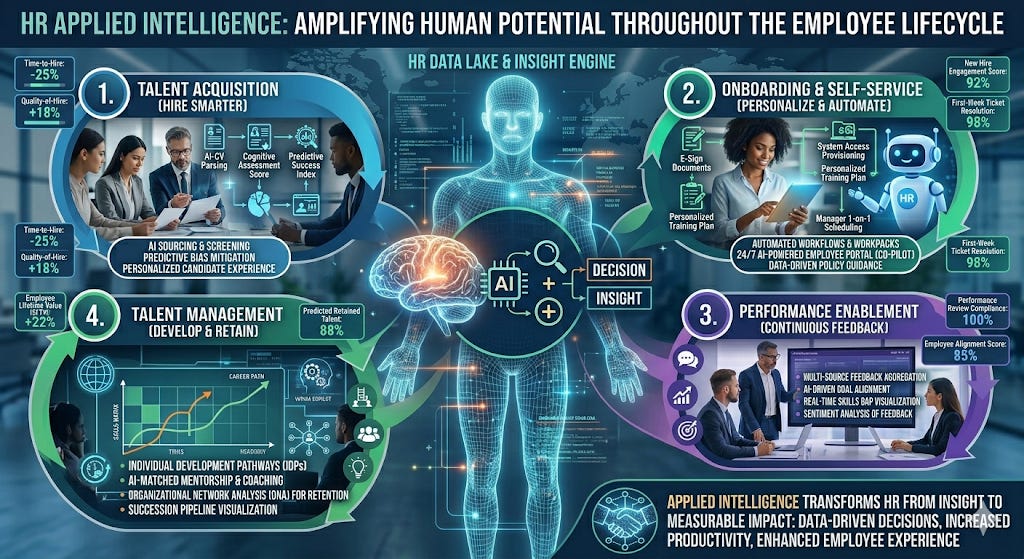
HR is no longer just responsible for managing people processes. It is expected to shape workforce strategy, enable business transformation, and deliver measurable performance improvements.
Yet, many HR organizations struggle to meet these expectations. Despite investments in digital HR, analytics, and AI in HR, execution often falls short. Initiatives remain fragmented, insights are underutilized, and transformation efforts fail to scale.
This gap between strategy and execution is where HR applied intelligence becomes critical.
It provides a structured, continuous, and expert-led approach that helps HR leaders translate insights into action and sustain performance improvement over time.
What is HR applied intelligence?
HR applied intelligence is a continuous, decision-support approach that helps HR leaders move from strategy to execution with clarity and confidence.
It combines practitioner expertise, structured diagnostics, and advanced technologies such as AI in human resources and workforce analytics to create a fact-based view of HR performance. More importantly, it ensures that insights are translated into targeted actions that drive measurable outcomes.
Unlike traditional consulting, which often ends with recommendations, HR applied intelligence remains engaged throughout execution. It also goes beyond isolated technology implementations by aligning HR strategy, operating models, processes, and data.
This makes it fundamentally different from conventional approaches:
Consulting-only models provide insights but lack execution support
Technology-led initiatives focus on tools without addressing the operating model and governance gaps
HR applied intelligence connects strategy, execution, and continuous improvement
By bridging these gaps, HR applied intelligence enables organizations to move faster, make better decisions, and sustain transformation outcomes.
Why HR leaders need applied intelligence now
HR leaders are operating in an environment defined by complexity, disruption, and rising expectations.
Workforce complexity is increasing
Hybrid work, global talent models, and evolving skill requirements are making workforce planning more challenging. HR must align talent strategies with dynamic business needs.
Pressure to improve cost and productivity
Organizations expect HR to deliver greater efficiency while improving workforce outcomes. This requires a more precise understanding of cost, capacity, and performance.
Fragmented HR processes and systems
Many HR functions still operate across disconnected platforms and inconsistent processes, limiting scalability and slowing execution.
Limited use of HR data and analytics
While data availability has increased, many HR teams struggle to translate insights into actionable decisions. Workforce planning and talent management often remain reactive.
AI in HR is accelerating
Artificial intelligence in HR is transforming areas such as recruitment, employee experience, and workforce planning. However, many organizations lack clarity on where AI will deliver the greatest impact and how to scale it effectively.
Rising expectations for employee experience
Employees expect seamless, personalized, and transparent HR services. HR must deliver high-quality experiences while maintaining efficiency and compliance.
Execution gaps persist
Many HR transformation programs fail to sustain momentum because they lack continuous guidance and structured execution support.
HR leaders are now required to balance cost, talent, experience, and innovation simultaneously. This level of complexity demands a more structured and continuous approach. HR applied intelligence provides that foundation.
How HR applied intelligence works
HR applied intelligence operates as a continuous model that supports HR leaders across the full transformation journey. It is typically structured around four interconnected stages:
1. Ideate and define
The process begins with establishing a clear, data-driven view of current HR performance.
This includes diagnostics and benchmarking across key HR functions, including talent acquisition, workforce planning, HR operations, and service delivery. Leaders gain visibility into gaps in cost, efficiency, capability maturity, and employee experience.
At this stage, organizations also identify opportunities for AI in HR, including automation, AI agents for HR, and advanced analytics use cases. The outcome is a prioritized set of initiatives aligned with business objectives and measurable impact.
2. Align and decide
Once priorities are defined, HR leaders evaluate options and make critical decisions.
This involves aligning the HR operating model, governance structures, technology landscape, and workforce capabilities. Trade-offs are assessed, and initiatives are refined based on feasibility, value, and readiness.
Leaders are supported through structured discussions, benchmarking insights, and real-world execution experience. The goal is to ensure that decisions are both ambitious and practical, setting the foundation for successful execution.
3. Execute and enable
Execution is where most HR transformations fail. HR applied intelligence addresses this by providing continuous support during implementation.
HR teams receive ongoing guidance to navigate challenges, maintain momentum, and adapt plans as needed. This includes:
Embedding automation and AI in HR processes
Standardizing workflows and improving service delivery
Enhancing data quality and analytics capabilities
Supporting change management and adoption
Generative AI and AI agents for HR can also be integrated at this stage to improve efficiency, decision-making, and employee interactions. The focus is on turning plans into tangible, measurable results.
4. Adapt and optimize
HR transformation is not a one-time initiative. It requires continuous refinement.
In this stage, HR performance is monitored, diagnostics are refreshed, and priorities are updated in line with evolving business needs. Regular expert check-ins and performance reviews ensure that HR leaders stay aligned with changing conditions and continue progressing toward higher levels of performance. This continuous cycle enables organizations to sustain improvements and remain agile in a rapidly changing environment.
Benefits of HR applied intelligence
HR applied intelligence delivers value by connecting strategic intent with operational execution. Its impact can be seen across multiple dimensions:
Strategic alignment and clarity: Aligns HR strategy with business objectives, helping leaders define priorities and measure impact more effectively.
Operating model effectiveness: Designs HR operating models that integrate governance, technology, and workforce capabilities for scalable execution.
Process efficiency and service quality: Standardizes and optimizes HR processes, improving efficiency while enhancing employee experience.
Cost and workforce productivity improvement: Identifies inefficiencies and enables better resource allocation, improving cost-to-serve and workforce output.
Enhanced HR analytics and insights: Strengthens workforce analytics capabilities, enabling predictive insights and better decision-making.
Stronger governance and risk management: Improves compliance, policy frameworks, and performance management across HR functions.
Improved employee experience: Delivers more responsive, transparent, and personalized HR services.
Future-ready HR capabilities: Builds digital skills, data literacy, and change leadership to sustain long-term transformation.
Conclusion
HR is at a turning point. Expectations are rising, complexity is increasing, and the pace of change continues to accelerate. Traditional approaches are no longer sufficient to meet these demands. Organizations need a model that connects strategy with execution and supports continuous improvement.
HR applied intelligence provides that model. By combining expert guidance, data-driven insights, and AI-enabled capabilities, it enables HR leaders to move from insight to action and sustain performance improvement over time. For HR leaders, the question is no longer whether transformation is needed. It is how to execute it effectively and continuously. A structured, applied intelligence approach ensures that HR is not only prepared for the future but positioned to lead it.